IntermediatePart of the Nervous
Brain
Encephalon
The body’s command center, integrating sensation, memory, emotion, and precise movement.
Explore in 3D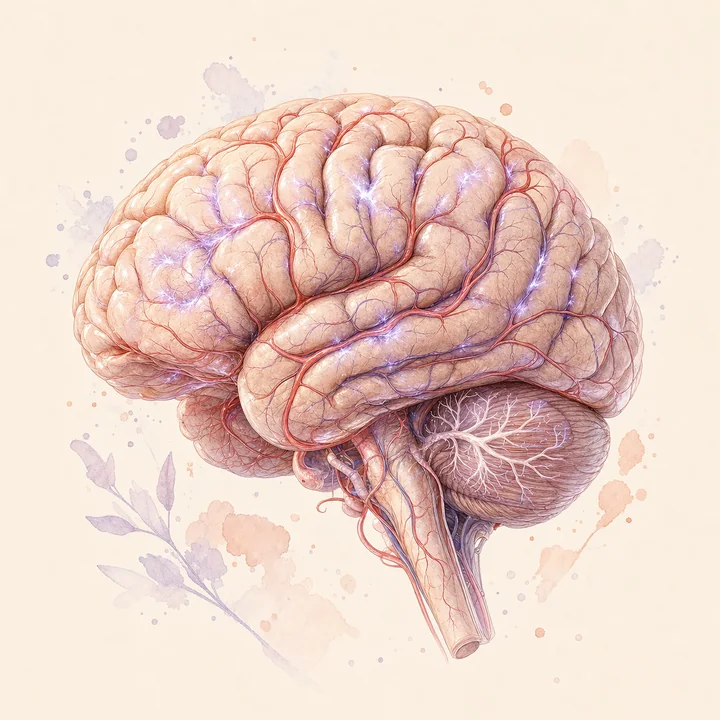
In short
Billions of neurons communicate through electrical and chemical signals.
It has no pain receptors of its own — a headache is felt in the tissues around it.
Key facts
- Size
- Roughly two clenched fists
- Weight
- 1.3–1.4 kg
- Location
- Protected within the skull
- Blood supply
- Internal carotid and vertebral arteries
- Function
- Processes and coordinates signals
- Daily
- Uses about 20% of the body’s energy
- Tissue type
- Cerebral cortex
- Latin term
- Encephalon
Structures to know
7 labelled structures
Frontal Lobe
Lobus frontalis
Planning & movement
Open Frontal Lobe in 3DParietal Lobe
Lobus parietalis
Sensory integration
Open Parietal Lobe in 3DTemporal Lobe
Lobus temporalis
Memory & hearing
Open Temporal Lobe in 3DCerebellum
Cerebellum
Balance & coordination
Open Cerebellum in 3DOccipital Lobe
Lobus occipitalis
Vision
Open Occipital Lobe in 3DBrainstem
Truncus encephali
Breathing & heart rate
Open Brainstem in 3DCentral Sulcus
Sulcus centralis
Divides motor from sensory cortex
Open Central Sulcus in 3D
Numbers at rest
Typical adult values — not a diagnostic reference.
Clinical relevance
Billions of neurons communicate through electrical and chemical signals.
- Migraine
- Stroke
- Neurodegenerative disease
- Epilepsy
- Traumatic brain injury
- Meningitis
- Multiple sclerosis
- Brain aneurysm
Study material only — this is not medical advice or a diagnostic tool.
Study next
Reviewed 2026-08-18 · Structure names follow Terminologia Anatomica (TA2).