AdvancedPart of the Sensory
Eye
Oculus
A precision sensory organ that converts focused light into neural signals interpreted as vision.
Explore in 3D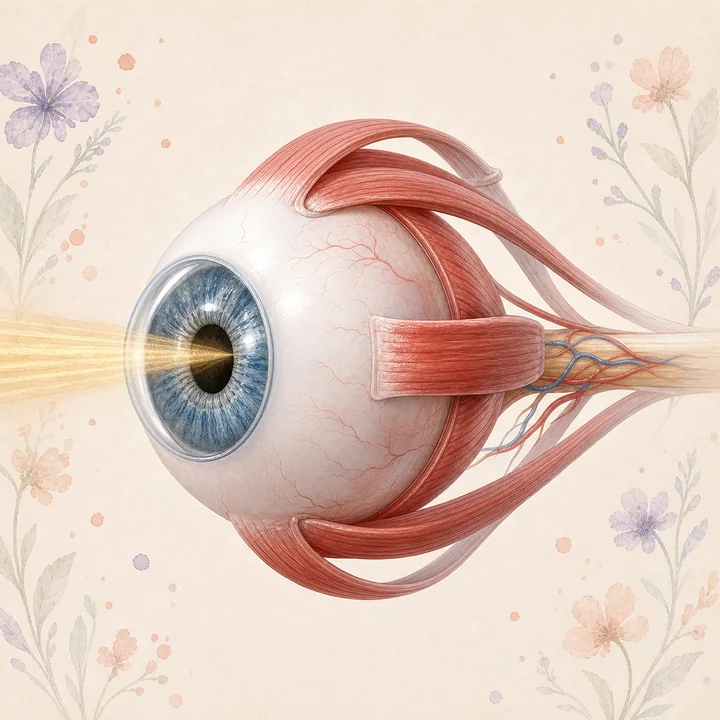
In short
The retina is an extension of the central nervous system.
The cornea carries no blood vessels at all; it takes oxygen directly from the air.
Key facts
- Size
- About 24 mm across
- Weight
- Around 7.5 g
- Location
- Within the bony orbit
- Blood supply
- Ophthalmic artery
- Function
- Captures and focuses light
- Daily
- Makes thousands of tiny movements
- Tissue type
- Retinal layers
- Latin term
- Oculus
Structures to know
6 labelled structures
Cornea
Cornea
Clear focusing surface
Open Cornea in 3DIris
Iris
Controls light entry
Open Iris in 3DOptic Nerve
Nervus opticus
Carries visual signals
Open Optic Nerve in 3DSclera
Sclera
The tough white outer coat
Open Sclera in 3DLens
Lens
Focuses light onto the retina
Open Lens in 3DRetina
Retina
Turns light into nerve signals
Open Retina in 3D
Numbers at rest
Typical adult values — not a diagnostic reference.
Diameter24 mm
Usual range 23–25 mm
Photoreceptors126 ×10⁶
Intraocular pressure15 mmHg
Usual range 10–21 mmHg
Blink rate15 /min
Usual range 10–20 /min
Clinical relevance
The retina is an extension of the central nervous system.
- Myopia
- Cataract
- Glaucoma
- Macular degeneration
- Retinal detachment
- Dry eye disease
- Astigmatism
- Conjunctivitis
Study material only — this is not medical advice or a diagnostic tool.
Study next


Reviewed 2026-08-18 · Structure names follow Terminologia Anatomica (TA2).