FoundationPart of the Integumentary
Skin
Integumentum commune
The body’s largest organ — a living barrier that senses touch, holds in water, and regulates temperature.
Explore in 3D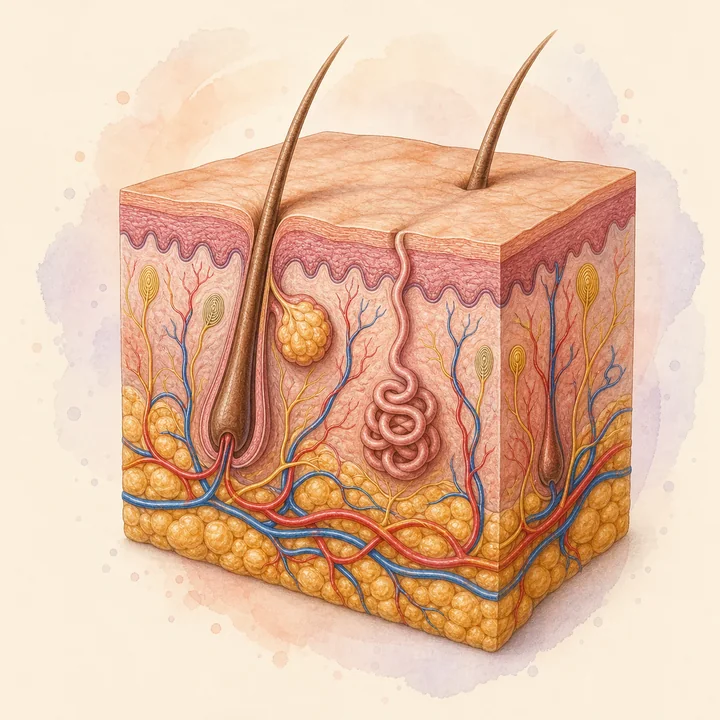
In short
Three layers — epidermis, dermis, and hypodermis — each with a distinct job.
A single square centimetre can hold hundreds of sweat glands and metres of blood vessels.
Key facts
- Size
- About 2 m² spread flat
- Weight
- 3.5–5 kg
- Location
- Covering the entire body
- Blood supply
- Dermal vascular plexus
- Function
- Protects, senses, and cools
- Daily
- Sheds around 500 million cells
- Tissue type
- Epidermal layers
- Latin term
- Integumentum commune
Structures to know
6 labelled structures
Epidermis
Epidermis
Outer protective layer
Open Epidermis in 3DDermis
Dermis
Nerves, vessels & glands
Open Dermis in 3DHypodermis
Tela subcutanea
Fat and insulation
Open Hypodermis in 3DHair Follicle
Folliculus pili
Anchors each hair
Open Hair Follicle in 3DSweat Gland
Glandula sudorifera
Cools the body by evaporation
Open Sweat Gland in 3DTactile Corpuscle
Corpusculum tactus
Senses light touch
Open Tactile Corpuscle in 3D
Numbers at rest
Typical adult values — not a diagnostic reference.
Clinical relevance
Three layers — epidermis, dermis, and hypodermis — each with a distinct job.
- Eczema
- Psoriasis
- Melanoma
- Acne vulgaris
- Cellulitis
- Contact dermatitis
- Rosacea
- Vitiligo
Study material only — this is not medical advice or a diagnostic tool.
Study next


Reviewed 2026-08-18 · Structure names follow Terminologia Anatomica (TA2).