FoundationPart of the Cardiovascular
Heart
Cor
A muscular organ that pumps blood throughout the body, delivering oxygen and nutrients to every cell.
Explore in 3D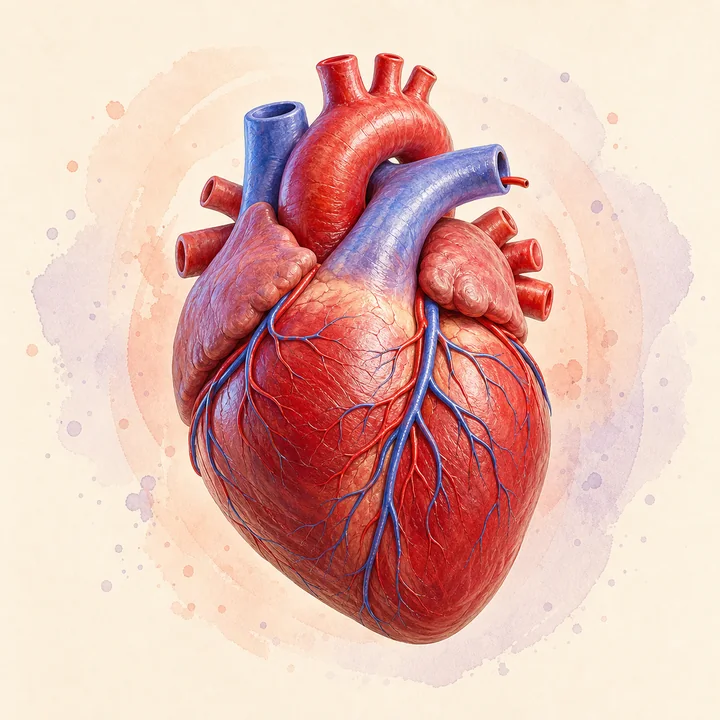
In short
Its electrical rhythm coordinates every heartbeat.
It beats roughly 2.5 billion times in an average lifetime, and starts before you are born.
Key facts
- Size
- About the size of your fist
- Weight
- 250–350 g
- Location
- Behind the sternum, slightly left
- Blood supply
- Left and right coronary arteries
- Function
- Circulates oxygenated blood
- Daily
- Beats about 100,000 times
- Tissue type
- Cardiac muscle tissue
- Latin term
- Cor
Structures to know
10 labelled structures
Aorta
Aorta
Main artery
Open Aorta in 3DLeft Atrium
Atrium sinistrum
Receives oxygenated blood
Open Left Atrium in 3DRight Atrium
Atrium dextrum
Receives venous blood
Open Right Atrium in 3DLeft Ventricle
Ventriculus sinister
Pumps to the body
Open Left Ventricle in 3DRight Ventricle
Ventriculus dexter
Pumps to the lungs
Open Right Ventricle in 3DMitral Valve
Valva atrioventricularis sinistra
Prevents backflow
Open Mitral Valve in 3DPulmonary Trunk
Truncus pulmonalis
Carries blood to the lungs
Open Pulmonary Trunk in 3DSuperior Vena Cava
Vena cava superior
Returns blood from above the heart
Open Superior Vena Cava in 3DApex
Apex cordis
The pointed tip, angled left
Open Apex in 3DLeft Coronary Artery
Arteria coronaria sinistra
Feeds the heart muscle itself
Open Left Coronary Artery in 3D
Numbers at rest
Typical adult values — not a diagnostic reference.
Clinical relevance
Its electrical rhythm coordinates every heartbeat.
- Coronary artery disease
- Arrhythmia
- Heart valve disorders
- Heart failure
- Cardiomyopathy
- Myocarditis
- Atrial fibrillation
- Congenital heart defects
Study material only — this is not medical advice or a diagnostic tool.
Study next
Reviewed 2026-08-18 · Structure names follow Terminologia Anatomica (TA2).