AdvancedPart of the Endocrine
Pancreas
Pancreas
A dual-purpose gland that releases digestive enzymes into the gut and the hormones that steady blood sugar.
Explore in 3D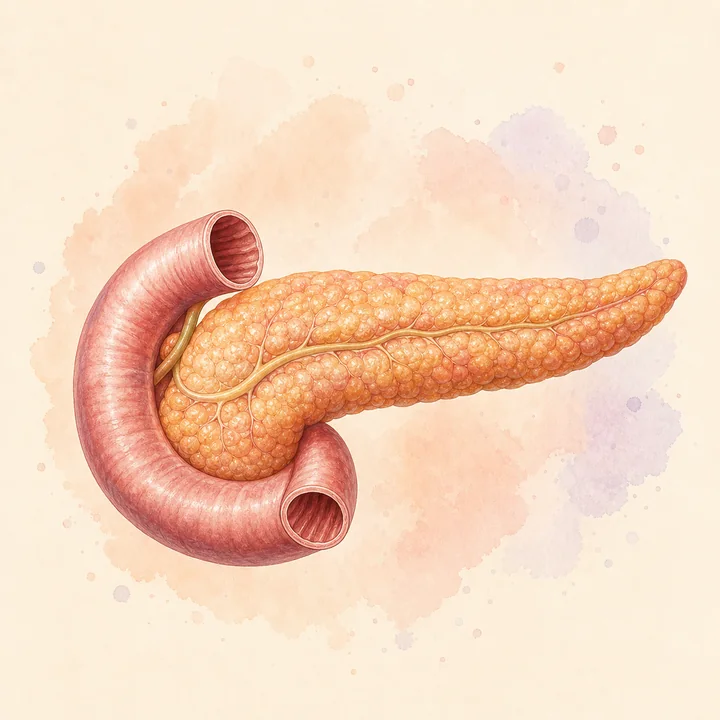
In short
Islets of Langerhans release insulin and glucagon to balance blood sugar.
Barely 2% of it makes hormones; the rest is given over to digestive enzymes.
Key facts
- Size
- About 15 cm long
- Weight
- 70–100 g
- Location
- Behind the stomach, across the upper abdomen
- Blood supply
- Splenic and pancreaticoduodenal arteries
- Function
- Digestive enzymes and insulin
- Daily
- Makes about 1.5 L of enzyme-rich juice
- Tissue type
- Pancreatic acini
- Latin term
- Pancreas
Structures to know
6 labelled structures
Head
Caput pancreatis
Cradled by the duodenum
Open Head in 3DBody
Corpus pancreatis
Crosses the spine
Open Body in 3DTail
Cauda pancreatis
Reaches the spleen
Open Tail in 3DPancreatic Duct
Ductus pancreaticus
Drains enzymes to the gut
Open Pancreatic Duct in 3DNeck
Collum pancreatis
The narrow join between head and body
Open Neck in 3DIslets of Langerhans
Insulae pancreaticae
Release insulin and glucagon
Open Islets of Langerhans in 3D
Numbers at rest
Typical adult values — not a diagnostic reference.
Clinical relevance
Islets of Langerhans release insulin and glucagon to balance blood sugar.
- Pancreatitis
- Type 1 diabetes
- Pancreatic cancer
- Type 2 diabetes
- Exocrine insufficiency
- Pancreatic cysts
- Gallstone pancreatitis
- Insulinoma
Study material only — this is not medical advice or a diagnostic tool.
Study next
Reviewed 2026-08-18 · Structure names follow Terminologia Anatomica (TA2).